Tuesday, November 5, 2013

Flashbacks to Israel (and the Iraq War)

A blog post by Adam. What happens when you it takes more than a month to finish a blog post? Long. Winding. Endless. If you feel like that's enough for you, read no more. If you want to experience it for yourself, don't say I didn't warn you...

Israel and the DR really don't have all that much in common. Different language. Different religion. Different food. Different landscape. Different kind of loud (Israelis and Dominicans can both be loud, but Israelis are pushy and Dominicans are joyful).

And yet, over the past few months I've often reflected on Israeli injustices as we've watched a terrible injustice unfold here in the DR. The issue at stake is the rights of Haitian Dominicans, a topic I've blogged about twice (If you refused to visit countries with problems..., A final walk in Santo Domingo). When we first arrived, there was a growing movement of Dominicans of Haitian descent demanding Dominican citizenship and the official identity cards that come with it (necessary for everything from going to high school, to getting married, to legally working). The Dominican government generally denied Dominican citizenship to people born in the Dominican Republic to undocumented Haitian parents, leaving these people essentially stateless. Still, with much effort some Haitian Dominicans had indeed convinced the state to grant them IDs, including one of Melissa's coworkers. When we first arrived, the Haitian Dominicans we met said it was just a matter of time before everyone born in the DR, regardless of their parents' background, would be granted Dominican citizenship (and IDs).

Then on September 23 the Constitutional Court ruled that people with Haitian parents would not be granted citizenship. Even worse, they stated they would examine records back to 1929 to determine who no longer qualifies for Dominican citizenship. People who had never known any home but the DR were no longer Dominican and apparently never would be (the decisions of the constitutional court can not be appealed). Not surprisingly, international condemnation was widespread, from CARICOM (Caribbean intergovernmental organization) to Amnesty International. It was bad. Bad enough to be a top story in the NY Times...Interestingly, since I started writing this blog entry, many countries, including Spain, have come out in support of the ruling, agreeing with the court that this ruling helps the government better define the status of undocumented immigrants. I can't help but wonder if this is driven by these countries ambivalent relationship to their own undocumented immigrants.

By now, the Dominican government has completed it's review of documents back to 1929 and only found 24,932 children of foreigners who were "irregularly registered," including 13,672 descendants of Haitians. In other words 13,672 people who were formerly Dominican citizens are now "Haitians" although they've never set foot in Haiti. On top of this, there are many thousands more Haitian Dominicans who never had citizenship and never will (these are people who were so hopeful about a change in the law when we first arrived).  In total, including the 13,000 newly stateless, there are likely at least 35,000 (and probably many more) stateless Haitian Dominicans in the DR today.

I just don't understand why the DR has chosen this route. As far as I can see it's not just bad for humanity, it's also bad for the country. Just days after the court's ruling there was a lengthy article in a local paper lamenting the fact that only one quarter of Dominican jobs are in the formal sector. According to the article, the informal economy, "does not contribute to social development with taxes and thus benefits from subsidized transport, subsidized energy and infrastructure paid for by the formal sector." I'm not an economist, but that doesn't sound good. And yet, denying citizenship to people who know no country aside from the Dominican Republic, essentially forces all of these people into the informal sector (or worse....my guess is not being allowed to go to high school might be related to criminality...remember, without documents you can't go to high school, let alone get a legal job). What then is the point?

Which brings me back to Israel. In Israel we saw all sorts of policies that seemed bad for the country. Some of these policies affected Palestinians and others affected Israeli citizens (Ethiopian Jews and Bedouins). In many cases there has been international condemnation, and yet, the government moves forward. Why? And why is the same thing happening in the DR, a country seemingly so different from Israel? And what about the US and the Iraq War? What is it? Xenophobia, racism, revenge, stupidity? Some things I may never understand...


Wednesday, October 23, 2013

Robbed...don't expect pictures anytime soon....

A blog post by Adam. Robbery is a problem in the DR. Just about everyone we've talked to has been robbed or knows someone who has been robbed. Sometimes during day time, sometimes at night. It is an unfortunate part of living in a country with poverty and high unemployment.  We therefore figured it was just a matter of time before we were targeted. We try to be careful about where we go and what we carry. But at the end of the day it's kind of hard to deny the obvious - we don't really look like we're from around here.

Well, as expected, it happened. Except that it wasn't exactly as expected. We were not held up on the street. And nobody broke into our house. Instead, someone opened Melissa's bag somewhere during her flights between L.A. and Punta Cana. They went through her jewelry (none of which they took) and pocketed her camera. It seems that it most likely happened either in L.A. after she checked in or in Atlanta while changing planes. In other words, we were probably robbed in the U.S.

For us (and this rambling blog) it means we will have a lot fewer pictures over the coming weeks. It also forces us to look at how we usually view the US (safe) as compared to how we see the DR (dangerous). The strange thing is that people here in the DR have gone above and beyond to help us out when we've left valuables behind. Once Melissa's phone slipped out of her pocket in a decrepit shared taxi. Despite the fact that every Dominican we spoke to said it was likely the driver who stole it, the driver in fact kept the misplaced phone under lock and key until we were able to retrieve it and prove that it was indeed our phone. Another time I left my keys hanging from the cabinet lock where I store my computer at the Clinic for a full night. When I returned to retrieve the keys the following morning the computer and keys were still there. It's true that theft is more common here than in the US, but as we have seen time and again during our travels, things are rarely as black and white as we imagine them to be.

Sunday, October 20, 2013

Fresh Fruits (and Juices)

A blog post by Adam. As far as I'm concerned they greatest thing about the Dominican Republic is not the world class beaches, or the welcoming and friendly culture, or the baseball. It is, hands down, the fruit. We've had lots of it, and we've tried more new fruits in the past 15 weeks than we had likely sampled in the previous 15 years.

To really know the fruit you need to taste it. But since Google's blogger website does not yet offer a taste function, we'll do a mini fruit (and juice) tour via pictures.  We'll focus on the most exotic, which means no pineapple or banana (always available) or mango (very popular and varied - the DR hosted the international mango conference in May).

Before I get to the pictures though, let me say that without our trusty Hamilton Beach blender (purchased at a California Bed Bath and Beyond for a fraction of the price of a similar blender in the DR) we would have never arrived at fruit paradise. Ultimately, it is the blending of tropical fruit, a fast moving blade, a little sugar, and sometimes some milk and ice that make fruit heaven possible.

Let's start with our favorite....Zapote or Sapote in English. On first sight it looks like a potato. Inside it's sort of like an orange avocado.....


It becomes the most amazing shake. Sort of tastes like a creamcicle milkshake....look at the happy customer.....


Carambola, or star fruit, is so uncommon here that our neighbor didn't even know what it was. We've never seen it in the store, but our Santo Domingo host family gave us a nice supply when we last visited them. Interestingly, several fruits, like starfruit and small guavas, are not regularly sold in stores, but are shared among people who have fruit trees at their homes. We think our host family likely got the star fruit from family who live in the countryside (there isn't a lot of room for trees in their second floor condo). Here we are preparing it for juice...


And here I am drinking it. As with most things, with a good amount of sugar it's pretty tasty.


While limoncillo also isn't in stores, over the summer it was everywhere on the street. It's sort of sweet and sour with translucent flesh and a large pit at the center. I find it mildly tasty and is best served with a generous supply of dental floss.  


Nispero. Or Dominican Loquat. Or Sapodilla. Tried it once. It was decent. Zapote is better.


Outside it usually looks pretty rotten.


Inside it looks like alien brains, either of the yellow or orange variety.


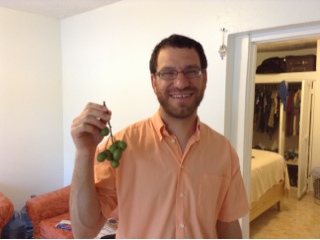
This is chinola (in the DR), or maracuya (in other Spanish speaking countries),or passion fruit (in English) and its juice is tasty. You throw the brains into the blender, blend briefly, strain it, return the unstrained residue to the blender for a second blending, strain again, add water and sugar, and you're good to go.
 
And finally, Dominican cherries, or cerezas. I think it's pretty good. Melissa thinks it's OK. Mina refuses to drink it because she overdosed on it when she was sick with dengue. That was three years ago. I guess the stuff provides a powerful and long-lasting punch.

Cleaning the cherries...


And drinking them...


There are of course other fruits we rarely (maybe never) see in un-tropical Washington, such as the aforementioned guava (stupendous in all forms), sour orange (amazing juice, a slightly sweeter limeade), guanabana (the subject of a previous post), and noni (used exclusively for medicinal purposes...we've never tried it). And this, my friends is just the beginning. During lunch the other day, a coworker spent a half hour describing various Dominican fruits that were foreign to most of the other Dominican clinic employees. I guess you'll just have to come here to experience it yourself.

Sunday, October 13, 2013

Six Months

A blog post by Adam. We left the United States six months ago today. We've been planning to be away for about a year, so I guess this is the half way point. It has gone by so quickly I can't believe it.

Strangely, I mark this milestone alone because Melissa is away at a friend's wedding for a week. And it is in her absence that I recognize the significance of these first six months. Our time abroad has been incredible. We've met amazing people, and visited beautiful places. We've experienced different cultures and tried new foods. We've created memories we will never forget. And while this blog itself has focused on what we've witnessed abroad, our trip has been much more about Melissa and Adam than anything else.

We have spent a lot of time together and we've been far more dependent on each other over these six months than at any other time in our young relationship. At times it's been hard and we've annoyed one another, but much more often it has been fun and rewarding. Overall, it has been the perfect way to start our marriage. I feel so lucky to be taking this trip and to be learning from each other and together on a daily basis. Before the trip began I knew I couldn't have done this trip alone. Now I know I wouldn't want to do it with anyone except for Melissa. Yes, it has been a terrific first six months. And I'm sure the next six months, and beyond, will only get better.


Friday, September 27, 2013

Complicated Traveling

A blog post by Adam. In celebration of Melissa's birthday we decided to go away for a long weekend to the Samana Peninsula. It would be our first multi-day trip on our own in the DR. We wouldn't have Mina's guiding nor driving support. It would just be us, our backpacks and a bunch of buses.

The decision to make the trip, however, wasn't so simple, and not only because we would be without Mina's direction. Our time volunteering, and particularly Melissa's experience at the grassroots organization, has changed us. At this point in our time here, we have met so many people who struggle to just get by. We haven't just seen them on the road or spent an afternoon with them. We have gotten to know them.

Melissa's coworker, for example, makes about $300/month (not an uncommon wage in the DR). She spends a third of her monthly salary on transportation costs to and from university, another large percentage on supporting family members and the rest on trying to pay monthly bills. Melissa's coworkers and most of the people at the Clinic have never been to Samana. They can't afford it. Could we justify such a trip? We debated. We struggled. We decided to go.

We caught our first bus from La Romana at 7:00 am. After another bus ride, a truck ride, a kilometer walk, and $30 in transportation fares, we arrived at Ecocampo La Sangria. It was incredible. Situated in the middle of a large pineapple farm, we had our own secluded cabin at the end of a guava tree lane. Lizards, frogs, and birds abounded and we felt a world away from La Romana. Plus, the grounds included a small swimming pool, and the price included a gourmet breakfast and dinner. All of this for just $50 a night.

As if the food and accommodations weren't enough, the Ecocampo was located just up the hill from Playa Rincon, which is apparently the second most beautiful beach in the world. We borrowed two barely functional bikes and snorkels and headed to the beach. We were not disappointed. The beach was amazing, but just as incredible as the beach itself was a fresh water river emptying into the ocean at the beach's edge. We walked up the river and then snorkeled down toward the sea. I couldn't see much because I'm blind without my glasses, but what I did see seemed impressive - tons of fish, rocks, moss, various underwater plants, and mangrove roots combined to create and underwater kaleidoscope of colors and textures. After the snorkel we ate freshly fried fish and drank a Coco Loco on the beach for about $20. We relaxed and reflected on the perfect day.

Playa Rincon
Melissa, biking to the beach.
The following day we took a tour of the surrounding farm, including a break to milk the cows.


The pineapple farm.
Adam milking.
After our morning farm tour we took a few more buses to Las Terrrenas at the other end of the peninsula. A town overrun by Europeans, we enjoyed beach time and a hike to an incredible waterfall. 

On the final night of our trip, we went out for a $5 drink at a restaurant right on the beach. We watched the moonlit waves crash onto the beach as our thoughts again returned to our lives in La Romana. Despite the fact that this very beach is only four hours (in bus) from La Romana, most of our coworkers will never see it over the courses of their lives. How strange it feels to spend our days working with people who are so committed to improving their country, and then go off for the weekend to parts of their country they will never know. We spent about $250 during our four days (bus rides alone cost $75). This is clearly beyond the budget of most people we know. 

We thoroughly enjoyed our trip at same time that we felt just as conflicted about it at the end as we had at the beginning.  We never imagined that volunteering and knowing a place and its people would make traveling so much more complicated. We have more trips planned. We wonder, how will we (and our coworkers) feel next time we pack our backpacks and hit the road?

Sunday, September 8, 2013

Charlie Thompson's Paradise

A blog post by Adam. Charlie Thompson, the same Oregonian Peace Corps Volunteer (PCV) that stocked our kitchen when he left the country, also left us with the key to the end of our five day adventure with Jorge and Mina: Sereno de la Montaña.

Although it was Charlie's favorite place in the entire country we had to admit we were a little skeptical. Charlie was incredibly generous and kind, but like many PCVs he lived comfortably with seemingly few material comforts. He slept on a mattress on the floor with no bed frame. He constructed his kitchen table from an abandoned piece of plywood. He appeared happy to eat anything placed in front of him. We figured his favorite place would be beautiful (being from the Northwest he had to know beauty when he saw it) but we also wondered if this forest getaway would feel more like camping than hoteling.

Well, Charlie, we never should have doubted you. We think we too have now found our favorite place in the DR. Sereno de la Montaña was incredible. It was simple, but comfortable and clean. From our deck we had an amazing view into the forest. 

The view at sunset.
The food was incredible, from Dominican standbys like yucca and beans and rice to more inventive fare including fried eggplant sandwiches. And then there were the excursions...a two hour inner tubing adventure down the river and a hike to a waterfall with an incredible swimming hole below.

Jumping into the swimming hole.
On top of all that we even got a mini dancing lesson from our guide, Angelica. And to everyone's surprise Jorge rose to the occasion, out-dancing all of us.


Jorge teaching Mina a few dance moves.
We had an amazing time and it was, without a doubt, the highlight of our trip. But that wasn't the only reason I was so impressed with Sereno de la Montaña. It was also impressive because its owners, managers, and employees were from the very small community where it was located. While we there, in fact, the community members held a meeting to determine the process of buying shares in the project. Too often we have seen just the opposite - foreign owned hotels with a few local service staff. This was something completely different. It was how we would hope tourism might be, good for the community and good for the tourist. Thank you, Charlie, for leading us to this paradise.

Thursday, September 5, 2013

An Unexpected Rosh Hashanah

A blog post by Adam. If you've ever found yourself at a High Holiday service, or perhaps any religious service, flipping through the prayer book trying to determine how much longer the service will drag on for, then this is the blog entry for you. It kind of goes on and on, unfortunately with no page numbers, but fortunately with a few pictures. You might just want to skip ahead to the pictures...I will not be offended.

The day after our 27 Waterfalls mishap, Rosh Hashanah, the Jewish new year, began. We found ourselves in Caberete on the Dominican Republic's north coast. Only a few miles down the road lies Sosua, where we hoped to spend Rosh Hashanah. Now well known as a sex tourism destination, it isn't exactly where you might expect to find one of the DR's two synagogues (the other synagogue is located in Santo Domingo).

Although a long time village, the town as it is known today was actually founded in the early 40s by Jewish refugees fleeing the Holocaust.  At the Evian Conference in 1938, where the world discussed the fate of the Jews, the DR was the only country to officially accept Jewish refugees. While the Nazis wanted to get rid of the Jews because they weren't quite white enough, Trujillo hoped the Jews might help whiten up the DR. It wasn't exactly where Europe's Jews expected to settle but sometimes you gotta take what you can get. Trujillo had big plans to make the DR far less brown and he offered 100,000 visas to Jews. Incredibly, whereas Jews were stripped of citizenship in Europe, they became Dominican citizens as soon as they arrived in the DR. In the end, only about 350 Jewish families settled in Sosua, and Trujillo's dream of a white DR never quite materialized. Many of the Jews who did come moved on after the war, and of those who stayed, many have now died. Nevertheless, the synagogue still stands.

About a week and a half before Rosh Hashanah, I began calling Sosua's Jewish community to find out about their Rosh Hashanah service schedule. The woman I talked to said that they were still trying to decide what they might do. I called back a few more times and she said it was still unclear what might happen. With no word about services, and the holiday set to start in ten hours, we decided to show up at the museum and synagogue. The woman I had spoken to graciously greeted us, but still didn't know what was going to happen. She promised to call. We knew things are pretty laid back in the DR, but this seemed a bit excessive, even by Dominican standards.

As we anxiously awaited a call about services, we were getting many calls from an unexpected source - the staff at 27 Waterfalls. They called after we left the visitor's center, where Melissa had fallen, to make sure we made it to the hospital. As we were on our way to visit Sosua's Jewish Musuem, they called to see how she was doing, and to inform us that we could submit her hospital bills to their insurance. Later when they called to check-in once more they said they had arranged for free admission to the Cabarete caves to make up for the fact that we never experienced the waterfalls. It may have been the best customer service I have ever experienced. We arranged to visit the caves on Rosh Hashanah afternoon.

And then, just when I had given up on services we got the other call. It was 4:30 pm. Services would start at 6:30 pm that night. We made it to services about 45 minutes late, but as expected, they weren't close to starting. Services were quick, but far more interesting were the post service conversations with some of the founding members of the community and their descendants. One man who was a small child when his family fled Europe noted that it had been a difficult transition for his parents, but for him and other kids growing up on the undeveloped beaches of the DR's north coast was a tropical wonderland.

And a tropical wonderland it was. We had our Rosh Hashanah lunch outside next to the hotel pool. We then visited the caves, two of which had small pools where we could swim. 


Mina, floating in a cave.
We ended Rosh Hashanah at an empty beach where we did Tashlich, a symbolic casting away of our sins. 


Mina, Melissa, and I at the beach, enjoying a granola bar after Tashlich.
The DR's north coast had become an unexpected refuge for Jews fleeing the Nazis. And for us, who have been lucky to live in an era of relative Jewish safety, the north coast provided an unexpectedly rich Rosh Hashanah - from meeting Holocaust survivors, to benefiting from extreme Dominican customer service, to spending time reflecting on the year past with family.

Tuesday, September 3, 2013

One Fall

A blog post by Adam. The plan was to jump down 27 waterfalls. Instead we had one fall, and then a rapid ride to a Puerto Plata emergency room.

This story, however, starts hundreds of kilometers away at Iberia, Melissa and my supermarket of choice in La Romana. It's big and it's cheap, perhaps only surpassed in value by the reputedly super inexpensive Cristo Viene, which we have not entered for obvious reasons ("Cristo Viene" means "Christ is coming" and I personally don't want to get caught in the produce aisle when Jesus shows up). Iberia sells groceries, clothes, electronics, medications, hardware supplies, and more. It has a good selection of imported and local products. It's only rival in town in terms of selection is Jumbo, La Romana's premier supermarket. 

Jumbo and Iberia differ in four significant ways. First, Iberia crams the same amount of merchandise as Jumbo in half the space.  Second, Iberia's prices, particularly for fruits and vegetables, are often half those of Jumbo's. Third, unlike at Jumbo, it sometimes feels like half the produce at Iberia is partially decomposed. Fourth, possibly due to either the space differences or the price differences, Iberia always seems about 54 times more crowded than Jumbo. Hopefully Iberia's unique place in the world is now clear. It's like Fred Meyer. Kind of.

Understanding Iberia's advantage (rock-bottom prices) and disadvantages (narrow overstuffed aisles, questionable quality, and crowds) we decided to check out their selection of water shoes, required equipment for conquering the 27 waterfalls (www.27charcos.com). And as expected, they did indeed have water shoes for the reasonable price of $5 per pair. I grabbed a blue pair, Melissa went with red. We felt good about the price.

A week and five hour drive later we found ourselves at the 27 waterfalls visitor center. We were with Mina and her husband Jorge, who was visiting the DR for a week. After eating our egg salad sandwiches and waiting out a torrential downpour we went to put on our swim suits and water shoes. Seconds after Melissa went off to change, Mina came running out yelling at me to come to the visitor center lobby. Melissa had put on her water shoes, taken one step in the bathroom, and fallen hard on the back of her head and elbows. The extremely cheap water shoes were lik eice skates on the slick bathroom floor. Melissa was in tremendous pain and everyone was concerned about her.

We decided Melissa had to see a doctor to make sure everything was OK beneath her throbbing skull. We hopped in the car and drove 30 minutes to a Puerto Plata hospital, where Melissa had a CT scan and everything luckily checked out OK. It was scary and Melissa continues to have lingering soreness. My fascination with good deals had not paid off. For probably the millionth time in my life, it had not paid to go cheap. I continue to feel bad. And I also continue to shop at Iberia. How difficult it is to change my ways.


It's good to be around family

A blog post by Adam. Yesterday was my maternal grandfather's 15th yahrzeit, or 15th anniversary of his death. Since my sister Mina and I live in the same building we decided to gather to remember our Grandpa. Both of our partners joined us as we lit a yahrzeit candle and shared stories.

Grandpa was an amazing person. An engineer, a fisherman, a woodworker, a classical music aficionado, a man totally committed to the Jewish community and our family. He was always so patient with us, whether we were working together in his wood shop, or trolling for trout on Lake Washington. He would spend hours just listening and talking to us. And whatever we did, he believed in us. If there ever was the perfect grandfather, it was him.

And though fifteen years has passed, he came back to life in our sharing. He was with us. As we recalled Grandpa's final computer publication - a sign welcoming Ari home from Israel - our eyes welled up with tears. Melissa and Jorge comforted both us, but looking across the table at Mina I felt so lucky. So lucky to have been able to remember one of my heroes with family, with someone else who truly understood where I was coming from.

Yesterday suddenly made me see my time in the DR differently. I still don't know if Dominican culture is a perfect match for my personality.  I don't know if I'll ever really become fluent in Spanish. I don't know if any of my projects at the clinic will have much impact on the DR, or the clinic for that matter. And I certainly don't know if my endless attempts to make Dominican beans will ever result in anything that is more than just slightly edible. But what I do know is that living downstairs from my sister for 7 months may be one of the greatest experiences of my life.

Sunday, September 1, 2013

Fleeting Friends

A blog post by Adam. I've been volunteering at the clinic for eight weeks and in that time I've already seen twenty international volunteers come and go.

Most of the other volunteers are students from Columbia University, either from the medical or nursing schools. They've generally come to the clinic for about a month and work on various projects, from helping with various research studies to helping with promotional and educational materials. They also spend a good amount of time shadowing doctors and other clinic staff.  I've enjoyed meeting the students and they have generally impressed me with their strong work ethic and interest in the clinic.

This constant stream of students is somewhat overwhelming. I was just getting to know the first group of students when they left. And then there were the international camp volunteers who came and went. Now, just as I learned the names of a group of eight nursing students they too left. How strange this must be for the clinic staff, as so many groups have filtered through the clinic over the years. It seems like it might make the staff's work more difficult and the patient experience less comfortable but perhaps at this point the constant ebb and flow of students has just become another part of the clinic environment, like the clinic's intermittent Internet.

For me it's been a great opportunity to meet a wide range of interesting intelligent young adults (most of the students are in their mid twenties). Unfortunately, in such short time frames, it has been impossible to to really becoming friends with any of them.  For example, Charlie's exit, which was the first departure I experienced, feels like a missed opportunity. A Peace Corps Volunteer from the Northwest, he was funny, smart, and generous. He liked the outdoors and yucca, and actually recommended a rustic eco-lodge where we'll be staying during our upcoming trip with Jorge and Mina. Charlie also gave us a ton of things as he cleaned out his apartment, which we have thoroughly enjoyed (Thanks Charlie!):

A sampling of the loot from Charlie
I think Charlie and I could have become friends, but alas he left 10 days into my volunteer assignment. I was left with hopes for what might have been along with many of his belongings. It makes it hard to invest a lot in relationships with other students knowing that they too will soon leave (although my understanding is that several of the incoming students will be here for much longer stints). With our temporary stay in the DR quickly passing I can't help but wonder if Dominicans look at us like I now look at the other volunteers. And how will this impact our ability to make real friendships, with foreigners and Dominicans alike?