Friday, June 21, 2013

Cockroaches and Ants

A blog post by Adam. We have arrived in La Romana, our home for the next 7 months. It's the Dominican Republic's third biggest city and has been my sister Mina's home for the past four years. I'll be volunteering where Mina works, La Clinica de Familia La Romana (www.clinicadefamilia.org.do) and Melissa will be at nearby 180 Degrees (http://en.180grados.info/). We're excited about settling down and putting together our first joint apartment.

We rented the apartment prior to going to Santo Domingo. It's a one bedroom in the same building as Mina's apartment.  When we first looked at the apartment it wasn't in the best of shape. It was dark and dirty. But by the time we left for Santo Domingo it was mostly repainted and was looking good.

Good looks, however, can be deceiving. When we first re-opened up our apartment the freshly painted  walls looked great. Then we opened our boxed up washing machine. And then a bag of random things we had left behind during our month in the capital. And then my large external frame backpack. In our absence, all of these locations had become breeding grounds for cockroaches. And boy did they ever breed. We did not count them, but there were many, many, many roaches of different sizes and colors.  It was incredible. It was disgusting. It was hands up-in-the-air shriek provoking. 

Have you ever taken a brand new washing machine out of a box that is crawling in little black critters? I'm guessing not. And I don't suggest you do, unless you are up for the fight of your life. With the aid of super poisonous "Baygon" spray and some quick foot stomping action, fight we did. We killed lots that first day and quite a few the next (on the second day we had a colony of cockroaches coming out of the kitchen sink).  Since then, we've killed several every day. Welcome to the tropics.

A dead cockroach on our kitchen floor.
Then last night, to accompany our evening roach, we had an army of itsy bitsy ants using our home as a thoroughfare. They entered through a small hole near the kitchen sink, snaked their way around our stove and refrigerator, went through the bedroom door, up over the bathroom door, across an entire bedroom wall, onto another wall, over our closet and out a hole on the other side of the room.  Given their small size this long distance was likely equivalent to us running at least a 10K, possibly more. We do not know where they were coming from or going, but they were moving at a frantic pace. We put a little poison on the path's entrance and within a half hour the thousands of ants were gone.

We will be leaving our apartment once again for more than a week, and we've decided we've had enough. We have nothing against exoskeletons, but we would prefer to live without them. We will have our place fumigated. It's probably not the best plan of attack for our physical health but I know it will do wonders for our mental health. There is nothing like the deathly fear of crossing paths with a harmless bug the size of a nickel during a mid night pit stop.

On a positive note, I learned that my external frame backpack is very easy to dissemble and wash. For the first time in nearly 20 years I took it apart and washed it. It looks amazing and smells pretty good too. Plus, I think I washed it so well, it could easily go another 20 without seeing a washing machine. Melissa may disagree.

Sunday, June 16, 2013

A final walk in Santo Domingo

A blog post by Adam. Four weeks goes by quickly. This is how long we spent in Santo Domingo.

I reflected on our time in Santo Domingo as I took a final walk in my favorite part of the city - Parque Mirador del Sur.  Each morning and afternoon the main thoroughfare though the five kilometer park is closed and it becomes a biking, walking, jogging and skating paradise. It's like Green Lake without a lake, wider walking paths, no cars within sight or sound, large flowering trees, and 90 degree/90% humidity weather. It is a unique oasis from hectic, noisy, and polluted Santo Domingo.

Bikers riding past a flamboyan tree in Parque Mirador.
The "Free Gym" inside the park.
Yet, as I strolled through the park our final morning in the capital, I couldn't help but acknowledge that Santo Domingo is so much more than first impressions. Like Israel, I've been touched by the people we've met here.  Our host family has been amazing. They've taught us so much about Dominican culture and cooking, and completely welcomed us into their family. Melissa's teachers and the staff at Entrena have all been equally welcoming and fun loving. 

In addition to the way we've been treated, a common bond among most of the people we've met here is that they come from somewhere else. It is, in a sense, a city of immigrants.  Some are from other parts of the Dominican Republic and others are from Haiti. The capital is more than just the seat of government or a historic center. It also represents hope for a better future for millions of Dominicans and Haitians. 

Santo Domingo, with its wealth, is the chance for a better life for so many. Our host parents are the perfect example. They were born in the poor countryside, moved to the capital, and now have two grown children who are highly successful professionals in law and banking.  Things can get better here.

Still, the poverty, the crime, and the lack of access to health care are all staggering in the DR.  I've written about the high unemployment and the challenges facing Dominicans of Haitian descent.  Compared to Israel, things here often feel far more hopeless. The problems are just that much greater. And yet, people have so much hope that things will get better. That if they work hard their lives will improve. That if they keep pushing, justice will prevail.

I saw this when I attended a recent protest of undocumented Haitian Dominicans in the capital. The mostly young adults who led the protest were full of life and hope that things would change, that the Dominican government would do the right thing and they would get documents. The hope was intoxicating. Interestingly, in private conversations with the few Americans at the protest, we heard a different story. They were completely pessimistic that things would ever change.

Dominicans of Haitian descent protest outside the National Congress.

Police stand guard at the peaceful protest.
And so as I took my final steps in Parque Mirador, and looked up at the beautiful flamboyan trees overhead, I thought to myself, am I on the side of hope or despair? My Jewish American background usually leads towards despair, but looking around at everyone exercising in such a wonderful park, I think that for today, at least, I will side with the Dominican Santo Domingo. I will choose hope.

Friday, June 14, 2013

Foreign aid

A blog post by Adam. Over the last month I've been volunteering for Entrena, the same organization where Melissa has been taking Spanish classes. Entrena administers several large grants related to children's education and youth engagement.  I've supported two grants by writing "success stories" of past participants, current participants and prospective participants.

It has been an incredible opportunity.  I've visited more than a half dozen communities in and outside of Santo Domingo, both urban and rural, all impoverished. I've spoken to many youth (some of whom I could barely understand), as well as educators, psychologists, and social workers.  

In Santiago, I met the director of Ninos con una Esperanza (http://www.kidswithahope.com/), an organization that works in the neighborhood at the edge of the city's dump.  "Overwhelmed" grossly underestimates my feelings as I sat with the dump in the background, hearing stories of kids who searched the dump for food they might eat and trash they might sell.  And then there was a young man in a rural Dominican town who shared his story of multiple surgeries, a single mother, eight siblings, and an extremely dilapidated house without a functioning bathroom.  These were just two of many unique experiences that have forced me to confront the Dominican Republic's seemingly insurmountable challenges.

Amidst this harsh reality, I was tasked with writing "success stories." Since one grant (from USAID) is rather new, the success stories focused more on prospective participants' hopes. The other grant, however, is several years old and there were more opportunities to find "success." Funded by the Inter-American Development Bank, the grant supports A Ganar, a youth employment program that combines sports, leadership development, and job training (http://www.partners.net/partners/History1.asp#.Ub2iceccdsk). It's a great concept and the youth I met seemed to generally like the program. As might be expected, the goal is to help youth get jobs, which is critical given the fact that young adult unemployment is astronomical.  

Sadly, after many interviews I have yet to meet a young adult who has kept a job for more than a couple months after completing the program. Today, I did meet a young woman who had secured a loan and opened her own successful corner grocery store since completing the program (a real success!), but she was smart and ambitious and I have little doubt that program or not she would have opened her store. She admitted she had asked the program for help with the loan, but was turned down so she found a loan on her own somewhere else. 

How much are these programs really helping? Even if some of the youth had secured jobs, wouldn't that just mean another Dominican was left unemployed? It's not as if there are thousands of openings here without applicants.  According to some non-reputable sources, people with university degrees can find themselves working at McDonalds because there just aren't jobs. It's true that many people are unprepared for the job market.  Unfortunately, the job market also seems to be unprepared for more workers.

I don't know what the answer is. But as far as I can tell the only ones who have secured stable employment through A Ganar are the ones employed at the various NGOs coordinating the project. Not that they don't need jobs too or that they're getting particularly rich...I briefly visited the house of a social worker today that was among the poorest I've seen - limited old furniture, appliances in disrepair, and tiny rooms.  Maybe they should just use the programmatic money to pay the NGO workers more since it seems that investing in job training without jobs doesn't work so well. I wonder, how do you create jobs in a poor country? 

Thursday, June 6, 2013

Boca Chica - Third time's a charm

A blog post by Adam.  Third time's a charm. I know it's a cliche. But in the case of Boca Chica, it works.

The first time we went to Boca Chica was in January 2012. We were with Mina, Jorge and my parents, and we went for lunch on our way from the airport to La Romana. It's located just minutes from the airport, and it has a beach and plenty of restaurants. After being hounded by a few restaurants and by many others selling things along the beach, we picked a restaurant at the end of the beach and consumed large quantities of fish and fresh juice. When the bill arrived, Mina exploded. The price was double or perhaps even triple what she expected.  She bargained hard with almost no result. We left a little less then pleased.

The second time we went to Boca Chica, it was a week later and the day before we were flying back home. We had an early morning flight and it seemed like the most convenient place to stay, given its proximity to the airport. At first glance, the hotel looked nice. But at 2:00 am, when the music at the bar next door was so loud we thought we were inside of the bar, comfortable was not the adjective that came to mind. After a sleepless night we boarded a plane hoping to never utter the name Boca Chica again.

The third time I went to Boca Chica was yesterday. I was not looking for food or place to stay, but a story. I've been doing volunteer work for Entrena, a Dominican organization that both offers Spanish classes to foreigners (like Melissa) and administers several large USAID grants throughout the Dominican Republic.  I'm helping collect oral histories for their newest grant, which focuses on youth violence and crime prevention. My goal is to collect inspirational stories to help kick off the grant, which brought me to Boca Chica, land of the Dominican tiguere.

What is a tiguere? According to UrbanDictionary.com a tiguere is "sneaky" person or a "thug". Think of a kind of sneaky thug...someone who is out to get you, but in a smooth kind of way.

Anyhow, in order to find an inspirational story in a place seemingly devoid of any type of inspiration I contacted Caminante (http://www.caminanteproyectoeducativo.org/), a grassroots youth organization.  Caminante staff connected me to Sony, a 34 year-old man who had lost both parents by age 14.  Shortly thereafter, he quit school and began living and working on the beach. With support from a nascent Caminante (he was one of the founding members), he went back to school, got a job at a nearby hotel, and then transferred to the restaurant business. After endless years of hard work, he now owns one of the larger restaurants on Boca Chica's beach. He admitted that without the support of Caminante he would either be dead or in prison. Instead, he is the father of four and a generous business owner, regularly providing funds and time to both Caminante and his church.

Sony talked about how youth continue to run Caminante and a staff person who was present during the interview conferred. They shared a story of how after hurricane George the youth decided to use the money the organization had raised for a summer camp to buy beds for people who had lost their homes. The youth went so far as to raise additional funds, and eventually provided 200 beds to community members. The staff person acknowledged that not all their stories ended so well, but that there were many positive endings (for example, her own...she too had been a former youth participant in the organization).

I began seeing Boca Chica in a new light. It wasn't just a home for tigueres, but also a home to deeply committed community members. It wasn't just about pushy restaurant owners trying to make a quick buck off of tourists, but hard working people trying to provide for their families and community. I now wonder how many other Boca Chicas I've visited where I've been too close-minded to see the inspiration that lies just beneath an ugly surface.

Saturday, June 1, 2013

Freedom

A blog post by Adam.  We relaxed in the morning, and then headed out for a luxurious lunch in a hut on the coast...

The hut.
Inside the hut.
After lunch, we walked a bit along the promenade next to Santo Domingo's coastline.  We came to a square where children who could barely walk were allowed to rent small plastic cars and drive them with minimal parental supervision.  Some children were frightened and refused to drive their rented cars.  Other children were fearless and proceeded to repeatedly crash into other children and onlookers.  It was good fun with little safety.

Melissa takes a break along the promenade.
It had been a full afternoon and we were ready to head back home. On our way home, however, we passed a barber hanging out on the front steps of his barber shop, "House of Pleasure"  I needed a haircut and the price was only $5.  We entered the House of Pleasure without thinking twice.

The music was blaring. And the mosquitoes were dancing.  Luckily the barber had an electrified tennis racket which he waved around my entire body prior to the cutting, killing every mosquito within a 3 feet radius.  He gallantly did the same for Melissa and handed her the racket when finished for her continued self protection.  Then the styling commenced...

He took his time, using different razors and scissors to cut my hair, shave my ear hairs, trim my beard, and sculpt my eyebrows. It was an intense treatment. With so much time on our hands we had a chance to talk.  The barber had lived in various parts of the U.S. for many years but had been deported 9 years ago. He prefers the Dominican Republic because there is more freedom here. The U.S. is crazy about rules and laws.  In the DR you can drink on the street (or as it happens, in a barber shop...in the middle of the haircut he asked a boy who was hanging out in the shop to grab his beer for him).  In the DR you can play your music as loud as you want (as it happens, the music in the barber shop was VERY loud, although he turned it down a few notches knowing our North American ears are sensitive).

It was a new perspective on a favorite American value. The barber had a point. You were free to do lots of things here that didn't really fly in the U.S., either because the laws here are less stringent or more likely because they aren't enforced. For example, people freely drive like maniacs (including children in small plastic cars), throw trash on the ground, and borrow electricity from power lines (our host brother who used to work for the state electric commission thought that as much as 40 - 50% of electricity in the country might be "borrowed").

Hundreds of electric wires crisscrossing a Santo Domingo street.  Is this regulated? 
I guess America's right wing is right that the U.S. is a totalitarian state...not that I've heard of many of them wanting to come to Santo Domingo to live in poverty and claim free electricity.

I don't think I'll ever be able to fully embrace the barber's Dominican style freedom. The problem is that when I look around, I don't see freedom (sadly, I also fail to see freedom in many corners of the U.S.). A few people here are doing well, some people are doing OK, and most are struggling.  The masses that are struggling just to make ends meet seem to have few opportunities and little freedom to choose how or where they live, what they do, and who they are.  They just survive, perhaps with a beer in the park and loud music from the corner store.  Is that freedom?

My haircut of freedom outside of the House of Pleasure.

Thursday, May 30, 2013

A culture of giving

A rather wordy blog post by Adam.

We needed to get home from the Zona Colonial and we vaguely knew the way. Our host mother told us to catch a bus to the University and from there we could find a bus home. How hard could it be?

After a few false starts we found a bus driver who confirmed that his route passed the University. We hopped on and hoped for the best. Shortly after we sat down a middle age man holding a stack of books and a bag of fruit stumbled onto the bus and sat next to Melissa and me.  I commented about his large Dominican history book, and that was all he needed to jump full force into conversation. 

After chatting a bit about his books, he pulled out a large greenish, beat-up fruit from his bag, and asked, "Do you know what this is?" We had no idea. Was it an unknown fruit? Or was it a fruit so manhandled that its distinctive traits were indiscernible?  As it turns out, it was a guanabana. We had heard of it. We had even drunk a Guanabana smoothie the last time we were in the Dominican Republic. This, however, was our first meeting in the flesh.

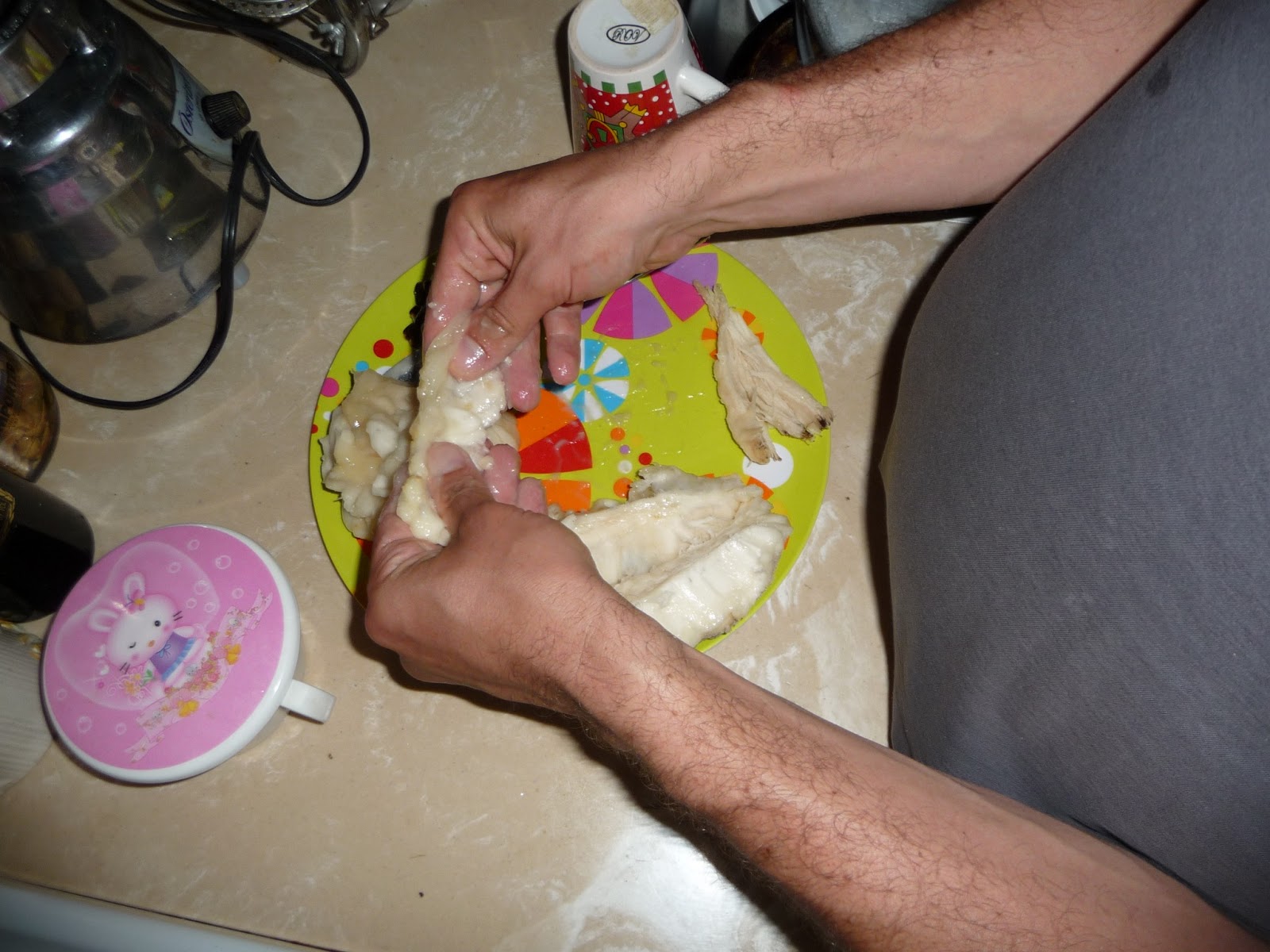
Our new friend proceeded to tell us how to turn it from green blob into a delectable white drink. You ripped the skin of with your bare hands, then used your fingers to pull the black seeds from the white pulp.  When the seeds were gone, you threw what was left in a blender, added some yogurt, milk and/or water, blended and drank. After his detailed explanation, he handed us the fruit, and told us to try it out at home.  We were speechless. We didn't know what to do. The woman sitting next to him nodded, "If he's offering you the fruit you should take it.  Don't worry, he wants you to have it."  We thanked him and the discussion proceeded with a rant against Neoliberalism and an additional gift of four mangoes.  

We were so engrossed in conversation and gift receiving, that we had lost track of the bus's route.  We turned to our companion and asked him where we were. Honduras. We were pretty sure we had not yet reached Central America, but we were also pretty sure Honduras was nowhere near the University.  We asked.  The University?  We passed that miles ago exclaimed several people on the bus. The bus screeched to halt, we grabbed our fruit and hurriedly jumped off, not even taking the time to thank our friend for the gifts.

From here we caught a public car (a shared car with a specific route) to the subway station, took the subway several stops and changed lines, came out of the subway, caught another public car, walked 10 minutes and made it home.

It was time to make a guanabana shake.  I quickly got to work, ripping off the skin and removing the seeds from the very slimy interior...

Removing guanabana seeds with belly protruding.  Is this a sign of stomach aches to come?
Removing seeds (from a different angle).  Why is my belly still sticking out?
I then threw the pulp in the blender with some yogurt, milk, and water and started blending. Problem was I wasn't so good at getting all of the seeds out. As the blender revved, a few seeds came to the top, but it felt like one escaped my grasp and had become part of the shake.  Melissa quickly ran to the internet to find numerous articles of dubious origin stating that the seeds were toxic.  She wasn't going to touch the stuff.  I myself wasn't so fearful of the seeds, but the finished product didn't seem right.  It was so thick and lumpy. I blended it some more and then gave up.  I had worked long enough and it was time to drink...

Gulping guanabana.
Problem was, with Melissa out of the drinking picture, and our host mother nowhere to be seen, I had a lot of thick guanabana beverage on my hands.  I couldn't waste it, so instead I gulped down about five glasses.  I couldn't force myself to drink a final sixth glass.  I saved that for breakfast the next morning.

Sure, in the end the drink was so thick, I actually had to used a spoon for the final two glasses.  And yes, it did give me a bit of a stomach ache and a lot of gas.  But mostly I was just blown away by how a stranger we met on the bus - a man who loved the Dominican Republic, but only had enough money to visit every so many years - had given us his only guanabana and half of his mangoes.  People had been incredibly generous to us in Israel, but this felt over the top. It was incredible.

And yet, it isn't the only generosity we've experienced in our short time here in the Dominican Republic. At Shabbat services we got invited to someone's house for dinner (we had already eaten dinner, but we graciously accepted the invitation, and somehow managed to put down a second dinner).  And our host mother prepares extra food at each meal for the old man who lives downstairs and has no family and a limited income.  I was impressed the first time I saw her bring him breakfast.  Now that I've seen her take him food daily I'm overwhelmed by her generosity.  We've learned much on our trip and had many inspiring experiences, but few things are more impressive than the generosity of every day Dominicans and the guanabana it brings.

Wednesday, May 22, 2013

Age and education

A blog post by Adam. While waiting in line at the Baha'i Gardens in Haifa (Israel), Melissa and I briefly talked to a retired U.S. engineering professor who was spending a few weeks at Haifa's Technion University reviewing the undergraduate curriculum.  The greatest difference between the U.S. and the Technion? Not so much the curriculum, but rather the students - the students at the Technion were several years older than American undergrads. Due to military service and traveling, the average student began university between 20 and 23 years old.  These few years and the experiences that accompanied them meant a much more mature student body.

This is proof that we did indeed visit the Baha'i Gardens. It is pretty much irrelevant to this post.
Fast forward a couple weeks and I find myself interviewing a 19-year-old recent university graduate in Santo Domingo. She had completed high school by age 16, and university only a few years later. The young woman was intelligent and given her challenging upbringing, mature beyond her years. Still, she seemed young, and I wondered how her lack of years impacted her.

After sharing her story with our host mother, we learned that Dominicans didn't usually graduate at such a young age.  Her age was a sign of her hard work, but it seems to also be a reflection of the poor educational system in the Dominican Republic.  With 36% of Dominican children not completing 8th grade, and the highest teen pregnancy rate in the Americas, the educational levels in the DR are low to begin with. But even those who do complete school may get a subpar education.  This was our host mother's explanation - sure the young woman was smart but she also went to mediocre schools where early graduation was possible. How different the system was from Israel or even the United States. This surely would be one of many reminders of the wealth and education disparities between the DR and so many other places in the world.

Saturday, May 18, 2013

A cave with a pool, a beach with warm water

A blog post by Adam.  Have you ever swam in a cave? In fresh water? I had not. Until today...

A short flat one kilometer hike through a cactus forest and other interesting plants and rocks, brought us here:

A cave...

 with water and...

 bats.

After a quick hike back to the car, we headed to the nearby beach, where we took a dip in the Caribbean.... 


A perfect first day off in the Dominican Republic.

Thursday, May 16, 2013

If you refused to visit countries with problems, where would you go?

A blog post by Adam. As we sat with a group of Haitian Dominicans in Guaymate, the words of an Israeli we had shared lunch with just one week prior suddenly came back to me. We were discussing our hesitancy to visit Israel given its long list of human rights abuses. The man, a Scottish Israeli who had helped save thousands of Ethiopian Jews, acknowledged Israel's problems but also asked how many other countries we had decided not to visit because of human rights abuses. Aside from my Hawaii and Safeco Field boycotts it was hard to come up with many other places on the no fly (and land) list. Still, who compared to Israel in the human rights abuse column? Sudan? North Korea? Maybe China? We weren't planning to visit those countries....

We are now in the Dominican Republic and what we learned on just our second day here is that human rights catastrophes know no borders. The four twentysomething Haitian Dominicans Melissa and I met work for the grassroots non-governmental organization 180 Degrees (http://www.180grados.info/). They were all born in the Dominican Republic and have lived here their entire lives. And while they all had official Dominican identification cards, the State has refused to renew their IDs since 2007 because of their Haitian roots. Without valid identification they are essentially stateless people, who can't go to high school or university, can't marry, can't open a bank account, and can't get legal work. There are tens of thousands of previously documented young people across the DR today who face this predicament. Amazingly, all four of the people we met were hopeful that the government's policy would change in the near future. Of course there were likely hundreds of thousands more Haitian Dominicans who have never had official identification, that may never be eligible for the simple ID cards that have so much power over one's life opportunities. It was a quick and harsh welcome to our new temporary home.

Tuesday, May 14, 2013

Landing in the DR

A blog post by Adam. Tel Aviv. Toronto. Newark. Punta Cana. La Romana. 3 flights. 30+ hours of travel, including 5 hours at Newark's America's Best Value Inn. One momentarily lost passport. And we arrived in the Dominican Republic. Very tired.


Melissa trying different sleeping positions in the Toronto airport.