Friday, February 28, 2014

Galapagos

A blog post by Adam (pictures by Melissa). I wanted to opt for a cheap boat. Melissa did not. In the end she was right. Because we paid a little more, we had an amazing guide and perhaps even more importantly lots and lots and lots of gourmet food. Unfortunately we never took pictures of the food, but here are some photos of what we saw...

A land iguana, showing off its claws (North Seymour Island).
A male frigate bird attempts to impress with an inflated red chest (North Seymour).

Blue Footed Boobie (North Seymour)

Two marine iguanas stretch out, attempting to cool off under the brutal Galapagos sun (Fernandina Island).

A giant tortoise with it's mouth full (Santa Cruz Island). 

Posing on a "tunnel" - a rare volcanic formation over the ocean (Isabela Island)

A 20 day old baby tortoise next to a tortoise shell (from a breeding center on Isabela Island)
A flamingo spreads its wings (Isabela Island)

Thursday, February 6, 2014

Saying goodbye

A blog post by Adam. On February 3, 2014we left the Dominican Republic. We first arrived on May 14, 2013. On June 15 we moved to La Romana and on July 1 we began our volunteer jobs. In the big scheme of things staying in a country for nearly 9 months, or living in the same city for 7 and a half months, or working at the same place for seven months isn't all that much. I was at JFS for 7 years, and had lived in Seattle for a total of 15 years before we left on our trip. Nevertheless, it wasn't easy to say goodbye.

Both Melissa and I had become accustomed to our apartment and our neighbors, particularly the two little girls and boy who lived in our building. We were also really starting to feel integrated at our volunteer sites. It was hard to say goodbye to neighbors and co-workers alike. 

For me, however, more than anything else, saying goodbye meant saying goodbye to Mina. During our time in La Romana I had gotten used to dinners with Mina, and trips to the beach together, and even sitting around her bedroom to watch Downton Abbey. I wondered if we would ever again share time like this on a regular basis.

I had also gotten to see Mina as an incredible manager at work. I don't believe I've ever seen a boss so devoted to her staff, so concerned about their personal and professional well-being. The board of directors knew all too well how she managed nearly 80 staff and a $1,000,000 budget as well as anybody could. But were they aware that every weekend she visited ill staff members in their homes, supporting both the staff and their families? Did they know she personally wrapped all the staff Christmas presents by hand? Had they ever heard how much she thought about staff who were struggling financially? My younger sister was not only one of my closest friends but also a role model. That's not something you can really replicate.

And so saying goodbye meant far more than just moving on to our next adventure. It meant trying to cherish an amazing time in the DR - the place we lived, the people we met, and most of all, the time with Mina.

The three of us on our second to last day in the DR (at Boca de Yuma).

Monday, February 3, 2014

Our home

A blog post by Adam. We have left the Dominican Republic, which seems unbelievable. Our time went by so quickly.

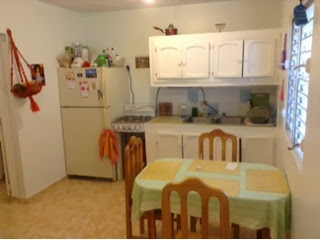
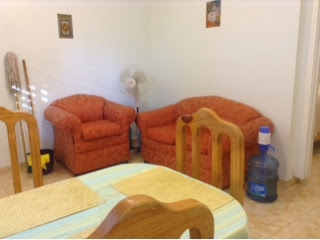
Much of our life there was been spent in our apartment, which we made into a nice bare bones home. It will was hard to say goodbye and so for posterity's sake, here is a quick tour of our home...

Our kitchen and diner room table. Note the location of the stove.
The stove...precariously propped up between the counter and fridge. Below it sits the full gas tank.  Very safe.

The living room, as seen from the kitchen. Nothing was too far away in our tiny home.
The bed and closet (in the bedroom)
The closet with doors open.
A view from the bed...desk, bedroom window, bedroom fan, drying rack, TV, and of course, washing machine.
The bathroom.
Melissa re-enacts toilet use in the bathroom. With about a foot of space between toilet and wall, it was a tight fit.

A view of the other side of the bathroom, including our mirror hung above the towel rack instead of the sink.

Friday, January 10, 2014

Climbing the Caribbean's highest peak

A blog post by Adam. For one and a half days we hiked up, and then for a day and a half we walked down. It was a good workout, but with mules carrying our gear, the 23 kilometer 6,000+ foot climb was certainly manageable.

It was an experience unlike any other during my time in the DR. First, there is something about being in the Caribbean and feeling truly cold, with temperatures in the 30s. Second, despite the fact that much of the island is forested mountains, it was the first time there were no signs of development for as far as the eyes could see. Third, although someone did bring a boom box and turned it on for a few hours at base camp (just below a sign that said "no music") it was probably the quietest place I had ever been in the DR. In general, aside from chatter while we hiked, camp fire storytelling, and a few mule neighs, silence enveloped the hike. After seven months of near constant music, loud voices, and crowing roosters, Pico Duarte was an oasis of rare calm.

Still, in the end it was very much like every other experience I've written about on the blog...once again the adventure was more about the people than the place. We traveled in a group of thirty from Santo Domingo to the peak and back. Most of our group was middle class (a poor person could never had paid for the $150 trip), but we also weren't the super wealthy....we met the wealthy folks along the trail. They ate gourmet meals served with placemats, silverware, and real plates and we mainly survived on boiled yuca and processed pork products (I stuck to large servings of yuca). 

It was a mostly Dominican crowd that also included three Americans from Clínica de Familia (Chloe, Amish, and me), a giant Quebecois PE teacher, and a small Finnish woman who was visiting a Dominican friend she had studied with in college in Saskatchewan. Among the Dominicans there was a father daughter pair from Santo Domingo, a young economist from the Dominican Central Bank hiking in loafers, a pair of woman friends, three young engineers from Santiago, and a guide from Sereno de la Montaña (who along with the Canadien PE teacher finished the hike in half the amount of time as the rest of us). 

With the economist and miles of undeveloped land.
In spite of our varied backgrounds, and the fact that most of us were strangers to one another at the beginning of the hike there was a level of camaraderie we have become increasingly accustomed to during our time in the Dominican Republic. Throughout the hike people stopped to check in on one another. Even more than that, they shared their meager food supplies even if it meant they themselves went slightly hungry (our middle class hike did not include lunch on the first 10 hour day of hiking which meant we were dependent on our own limited food stocks to keep us going - for the record, I packed 4 PB&J sandwiches so I was doing better than most). At meal times we gathered around and shared stories and on the final night we came together to swap jokes. When we parted after 3 days together there were lots of hugs and handshakes.

I admit I haven't been on many organized trips in the US, so perhaps the same level of friendship would quickly congeel on a similar trip in the U.S. Still, human connection in the Dominican Republic is something special. It's something contagious...even I found myself offering my not so tasty but critically important sandwiches to other hikers. Time and again I am impressed by how open, generous, and caring Dominicans are with one another (and with foreigners like me). Thus, surrounded by Dominicans, I could still feel warmth even at the Caribbean's coldest highest point. 

At the top of the pico with my fellow Americans and the man from Sereno de la Montaña

Wednesday, January 1, 2014

Insured

A blog post by Adam. On January 1st the Affordable Care Act became the law of the land and although Melissa and I are abroad we became insured in the United States. Yes, that's right, we got onto Medicaid. I'm not sure if Medicaid expansion was intended for people with two master's degrees, or for people who quit their jobs to travel abroad, but it doesn't matter because based on our income (which is all that really matters) we qualify.

Incredibly, because we opted to have Group Health as our provider I get to keep my same primary care doctor and nothing really changes for me accept that I no longer have premiums, co-pays, or co-insurance. President Obama has been far from perfect, but at least today (and probably each time I have to see the doctor after returning to the U.S.) I have to thank him for doing what no other president before him was able to do. Happy New Year and Thank You Barack Obama.

Another happy Medicaid recipient (with his Provider One. Card as proof).

Tuesday, December 10, 2013

A trip home

A blog post by Adam. Following visits by friends Leah, Sean and Delcia it was our turn to be visitors - visitors from the DR to our home in the United States.

Though we were home for two weeks, it was a bit of a whirlwind. Santo Domingo, Seattle, Olympia, Vancouver, Corvallis, Bend, Portland, Olympia, New York, Boston, Punta Cana. We spent no more than three nights in one location, and most places we stayed for less than 48 hours. It was wonderful to see so many friends and family, even if just for quick visits.

Still, it was a good reminder as to why our home is in the Northwest. Yes, it's nice to be from a place with beautiful views, when the clouds part. And I like how when I accidentally open my mouth in shower I don't have to immediately spit out the water for fear that it might cause a gastrointestinal illness. Plus there is the endless variety of restaurants. It is without a doubt a comfortable life in the Northwest, but most of all it is a life with lots of family and friends nearby.

We are very friendly with our coworkers at our various volunteer sites here in the DR and it has been incredible living so close to Mina. We don't, however, have close Dominican friends and attempting to play hide and seek with Vida and Simone via Skype just isn't quite the same as doing it in person. It's hard enough to stay in touch with people when we live in the same city or just a state away. It has proved quite a bit harder maintaining contact from across the world. It's wonderful to travel, but coming home gave us a glimpse of what it means to live abroad.

Which is a funny thing because we aren't really living abroad. We're spending a year abroad, travelling, knowing we will return home. The same isn't true for so many immigrants to the U.S., including thousands of Dominicans. For economic reasons or for immigration restrictions traveling to and from the United States isn't a luxury most can afford on a regular basis. Countless times we've talked to Dominicans who haven't seen relatives for years.

In just a few months we will return to the U.S. for good. We will almost surely miss the people and sun of the DR and the daily adventures of traveling. But I have a feeling it will also be good to wake up each morning and know we are home, closer to all the people that turn a place into a home.

Sunday, November 17, 2013

Chewing Cane

A blog post by Adam. We are living in sugar cane country. Here in La Romana it seems that Central Romana, the country's largest sugar cane producer, controls everything. They own most of the city's waterfront property (a wonderful place for a walk or run if you're white and you're able to get past the security guards). They operate the city's fanciest hospital. They developed Casa de Campo, one of the DR's most exclusive and largest resorts, complete with four golf courses. And now that the sugar cane harvest is on, they have people working at their plant 24 hours a day, 7 days a week, churning out lots and lots of sugar.

All of that sugar cane comes from the fields surrounding La Romana, including all of the land around Guaymate, where Melissa is volunteering.  So in late November, while Leah was staying with Mina, Melissa brought home some raw sugar for us to sample.  The challenge is that if you don't buy sugar in a bag, you have to rip off the tough outer layer, before sucking on the sweet interior. Since I'm sure you're dying to see how this is done, here a few pictures to give you an idea...

Ripping off the tough cane exterior.

Almost ready for consumption.

Finally....sucking on the cane.
Mina, enjoying La Romana's finest crop.

Friday, November 15, 2013

History and Friendship in Cap Haitien

A blog post by Adam. Happily, our plane from Port-au-Prince landed in Cap Haitien without incident. We had a reservation at an extremely expensive hotel, and so we decided to stop by a cheaper alternative on our way, just to see if we could save a substantial amount of money. As it turns out, something about the smells, lack of light, and general security concerns made the the cheaper option a questionable proposition for even thrifty Sean or me.

The nicer hotel was much nicer, with good light and pleasant smells. Better than the hotel itself, however, was its location. Across the street from a bay, a long even clean streetlight-illuminated sidewalk straddled the sea wall along the water. Each of our three nights in Cap-Haitien we would stroll on this walkway, accompanied by Haitian walkers and students, who came to do their homework beneath the rare operational street lights. It was the nicest urban landscape we saw in Haiti and it was only steps from our hotel. Instantly we felt worlds away from Port-au-Prince.

Cap-Haitien would thus be a very different experience than our previous three days in Haiti. Whereas the capital had been an opportunity to experience Haiti's contemporary arts, Haiti's second city would be our chance to go into country's past. Our first stop was the Citadel and San Souci, possibly Haiti's most spectacular sight. Christophe, who ruled northern Haiti immediately following independence from France, built this impressive fortress and palace about 200 years ago. As always, the journey to the sight was as eventful as the sight itself. It involved a taxi, a tap tap, a walk, and then a long time on a horse up into the mountains. It was well worth it. The Citadel and its surroundings were like nowhere I had been. It is no wonder that this fortress built to protect Haiti from foreign invasion was never attacked. 

Melissa with her horse, Fifi.
Sean and Delcia pose with the Citadel
The Citadel with a view of the hills and the Caribbean in the background.
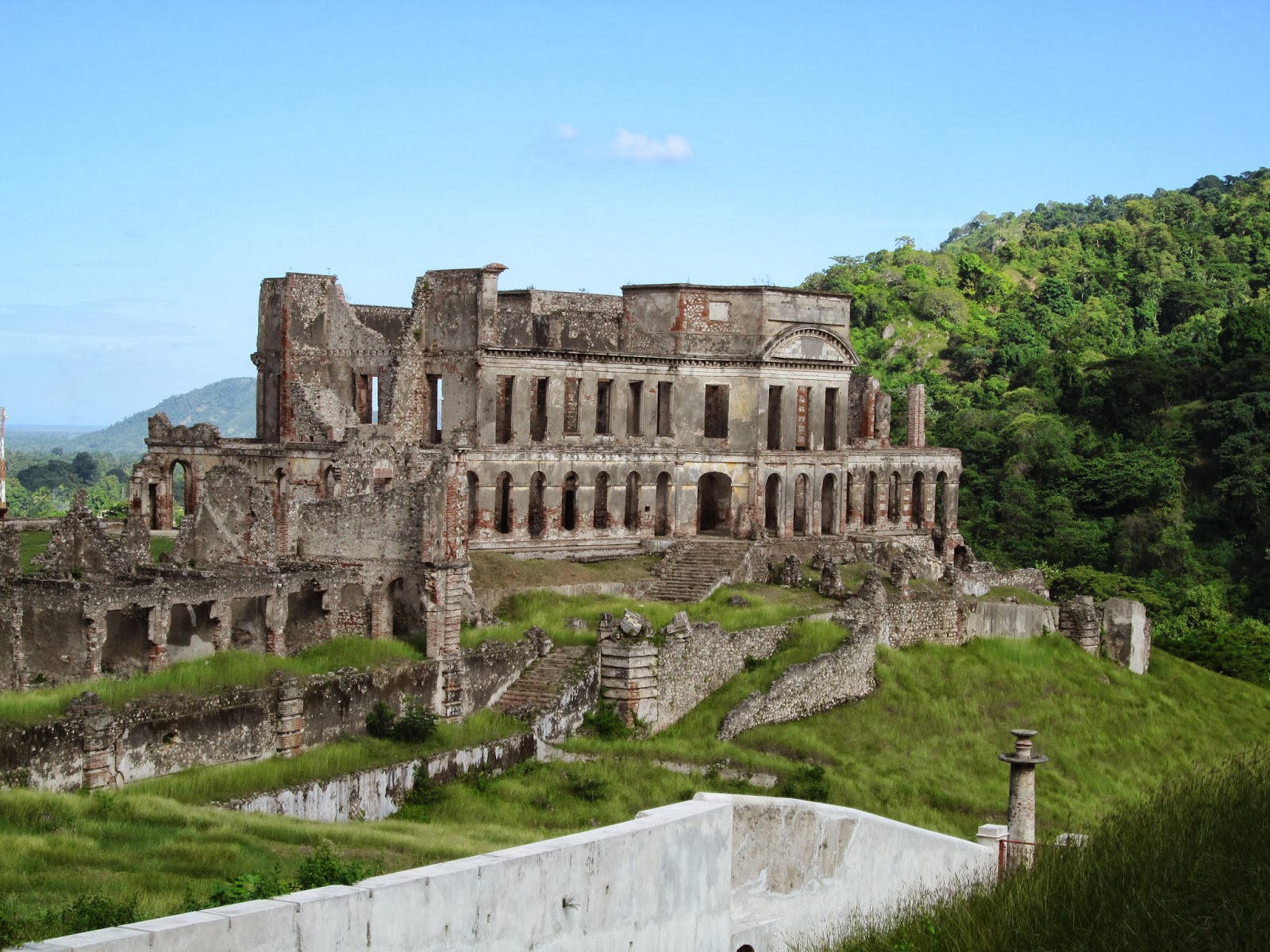
Christophe's palace, San Souci, was destroyed in an earthquake following his suicide (he was about to lose power and decided he would rather die than be ruled by someone else). Still, from what remains, it's clear it was a palace to rival any European palace of the time.

San Souci, still impressive even without a roof.
At its prime, the palace was full of busts imported from Europe. Today only this bust remains.
Having seen the splendor of Haiti immediately following independence on our first day in Cap-Haitien, we spent our second day seeing a little more recent history - the architecture of Cap-Haitien. While both humans and nature have destroyed the city five times since it was first founded several hundred years ago, its downtown still boasts beautiful architecture, full of color and balconies.


An example of Cap-Haitien architecture
Our final stops in Cap-Haitien included the bank and the city's only ATM machine, where we met a Chilean UN peacekeeper, a visit to the local beach, and a guest visit to a merchant marine English class. Once again Haiti's contrasts were ever present. The spectacular Citadel, beautiful architecture, and incredibly welcoming Haitians (the merchant marine school welcomed us in like we were celebrities...we were after all tourists in Haiti, which shocked them) in stark relief against a city with little infrastructure (only one ATM!), a history of violence (hence, the peacekeeper...although the peacekeeper said that the violence of a decade ago had mostly disappeared and his mission was now focused on various aid projects), and a lot of trash (it was the dirtiest beach I've ever seen...so dirty that we opted to stay out of the water).

After three blog posts on Haiti, I think it's pretty clear that it isn't such an easy place to travel (I even said so much in my first post). It's the poorest country in the Western Hemisphere, and the signs of poverty are ever present, even amid the country's tremendous artistic, historic, and natural beauty. Ultimately, it takes a certain kind of traveler to make the trip, and we were lucky enough to have friends who were up for the adventure. Leah, Sean and Delcia were wonderful travel companions and turned a challenging experience into an adventure. And of course without Melissa's French, it's hard to know how we might have survived. Going to Haiti was undoubtedly a unique opportunity, but I'm pretty sure I would never have done it alone. I'm happy I did it, but I'm even happier I had such great friends and a wonderful partner to do it with. 

Thursday, November 14, 2013

Darkness and Art in Port-au-Prince

A blog post by Melissa and Adam. Haiti was an amazing and intense experience. And it started as soon as we arrived at the border. First, we had the interrogation. Then we had a slow going gravel road for many miles. And then we had the traffic. As we came into Port-au-Prince we rolled to a stop, at one point moving about five feet in a 30 minute span. Not only was traffic overwhelming, but this city of more than 2 million people was dark. Yes, it was night (after all, more than 10 hours had passed since our "six-hour" bus left Santo Domingo), but night in most cities is full of bright lights. Surrounded by hoards of people and cars and no electricity, the bus crawled through Port-au-Prince's suburbs, finally arriving 11 hours after departing. We were no longer in the Dominican Republic.

We were exhausted, but we decided to rally for a Thursday night RAM concert at the historic Olaffson Hotel. RAM is a Haitian "roots" band, that plays into the wee hours without fail every Thursday night. The music was loud and fast and the large band was accompanied by a trio of tireless dancers (check it out yourself here). While the darkness and crowds of hours before were one side of Port-au-Prince, this artistic music was another. In the days to come we wouldn't see tourists, but we would see more darkness, corner stores lit by candlelight and a vibrant culture teaming with artists and musicians.

We spent three days in Port-au-Prince. On our first day we visited both the national museum and the Iron Market. The museum was small but good - we learned a bit about Haitian history and saw the anchor from Columbus' Santa Maria. We also learned about Konpa, another form of  upbeat Haitian music. The Iron Market was beautiful in its own right, newly reconstructed following its destruction in the 2010 earthquake. We had our first taste of Haitian visual art, which was as colorful and interesting as the music from the night before.
The entrance to the reconstructed Iron Market.
More impressive than the Iron Market, however, was the informal market around the Market. For blocks and blocks and blocks (perhaps we should say miles and miles) the market spread out in every direction. The market had completely taken over some streets, leaving just enough space for a trim human to walk between stalls. On other streets, horns honked incessantly as drivers tried to weave through traffic, vendors, and endless streams of pedestrians. Everything was for sale. A small sampling of items for sale included rusty computer parts, food (prepared and raw), phones, shoes, clothes, books, hair products, plastics, and lots of bagged water.  And on the few patches of ground not occupied by human beings there were tons of trash, much of it a thick carpet of discarded plastic water bags. The trash presented a sad contrast to an otherwise lively market scene, including the beautiful Iron Market.

Your average Haitian market stall.
That night we made a picnic dinner on the terrace of our hotel, which looked over much of the city. Here and there lights appeared below, but it was far from a bright scene. With night falling on the scenery below, we planned a trip to Croix des Bouquets, an area of town with blocks and blocks of Haitian metalwork artisans. We hoped the next day's trip would bring more art and less darkness.

To get to Croix des Bouquets we had to take a tap tap, or the perfect representation of Haiti in vehicular form. Only in Haiti would public transportation become such an elaborate work of art. We also have rarely had a louder, less comfortable ride. Tap taps come complete with a blaring staring system and people are packed in like sardines. Nonetheless, with assistance from helpful and friendly Haitians, we safely made it we made it to the metal work center.


A tap tap, complete with a note to God in English (perhaps specially made for us non Haitian Kreyol speakers).
Not be topped by the tap taps, the art in Croix de Bouquet was also fantastic. Made out of pounded out, discarded steel drums, the men worked tirelessly. Some women in the shops told us that they made metal work, but we never saw a woman pounding the metal. The artists used rudimentary hammers and chisels to pound out delicate works of art. They created everything from trees to scenes of Haitian musicians to miniature tap taps. We likely visited at least 15 workshops, and purchased far less than we appreciated.


Pounding out art in Croix des Bouquets

This is an example of a finished product from a website that sells Haitian art. 
We returned to our hotel in the early evening, took a rest, and then headed out to find a nearby restaurant. Our hotel was located in one of the nicer parts of the city, full of very large houses and good hotels. Like the rest of the city, however, there were no street lights and very limited sidewalks. And as it turned out, there were no restaurants either, despite mention of restaurants in the guidebook. We returned to the hotel, where we ate our final dinner in Port-au-Prince. Whereas the day had been a feast of one of Haiti's greatest assets (the art), the night was a reminder of Haiti's struggles (a lack of light and tourist infrastructure).

Our final day in Port-au-Prince included a visit to the city's labyrinthine cemetery (full of art and disorganization), a stroll to an art collective (lots of phallic art), and a quick stop in Petionville, one of Port-au-Prince's nicest neighborhoods (where we bought yet one more piece of art). We ate some lunch and headed off to the airport. We leisurely waited at the terminal with Sean and Delcia, prepared to fly to Haiti's second biggest city, Cap Haitien, and Leah awaited her flight to Santo Domingo.

After 30 minutes of waiting we realized only Leah was in the correct terminal (international flights only). Upon realizing this fact, we frantically said goodbye to Leah and jumped in a cab to the domestic terminal (a ride that lasted 2 minutes and cost $25 US...and this was after a bit of haggling). It was a chaotic end to a chaotic mix of positive and sad feelings about our time in Port-au-Prince. We wondered what surprises Cap-Haitien would offer as we boarded a very small plane Melissa feared would go down somewhere in the mountains along the way.

Adam in front of our little plane, ready for more adventures.